




If you’ve ever tried to sleep in your loft conversion during a July heatwave, you’ll know how uncomfortable it can get. I’ve had customers in Lincoln tell me their bedroom felt like a greenhouse by mid-afternoon, even with the windows open. It’s one of the most common complaints I hear, especially from families who’ve recently invested in a smart new loft room only to find it’s unusable for a few weeks each summer.
The good news is that there are sensible, effective fixes, including modern air conditioning solutions designed specifically for homes. Before we get into that though, it helps to understand why loft conversions get so hot in the first place.
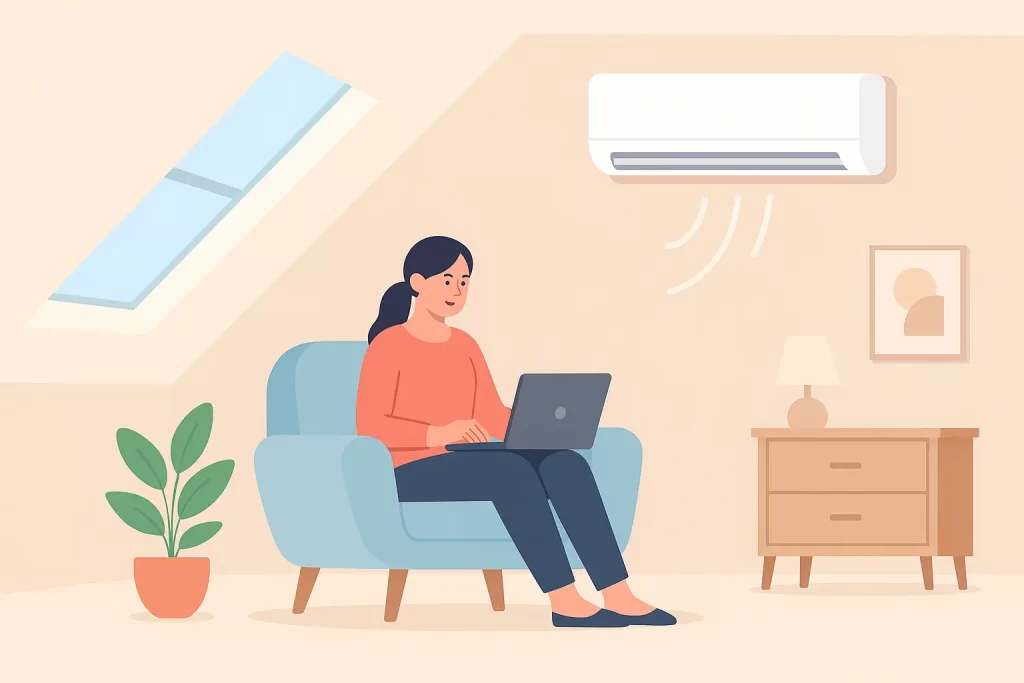
Why loft conversions overheat in summer
Heat rises. We all know that. But in a house, it’s not just rising warm air that causes problems. A loft sits right under the roof covering, which in the UK is usually dark tiles or slate. On a sunny day those tiles absorb a huge amount of solar energy. I’ve measured roof void temperatures well over 50 degrees on a warm afternoon.
In a standard unused loft, that heat can build up without bothering anyone too much. Once you convert it into a bedroom, office or playroom, you’re suddenly asking that same space to stay comfortable with people inside it.
Even a well insulated loft conversion can struggle because insulation slows heat transfer but it does not stop it entirely. Over the course of a hot day, warmth gradually makes its way through the roof structure and into the room.
Common causes of heat build-up in loft spaces
Large roof windows
Velux style windows are fantastic for natural light. The downside is that they also let in direct solar gain. A south facing roof window with no blind can turn a loft into a sunroom by lunchtime.
Poor ventilation
Many loft conversions rely on opening one or two windows for airflow. On still days that simply is not enough. Warm air sits up high and without proper cross ventilation it has nowhere to go.
Limited shading
Unlike lower floors, lofts rarely benefit from trees, neighbouring buildings or overhangs providing shade. The roof surface is fully exposed for most of the day.
Modern airtight construction
Building Regulations rightly focus on insulation and air tightness to improve energy efficiency. The downside is that heat which gets in struggles to escape. I often explain to customers in North Hykeham that their lovely, well sealed loft is doing exactly what it was designed to do. It just was not designed with 30 degree UK summers in mind.
Effective ways to cool a loft conversion
There isn’t one single fix. It’s usually about combining a few sensible measures.
- Install blackout blinds or solar reflective blinds on roof windows. These can significantly cut down solar gain during the hottest part of the day.
- Improve ventilation by ensuring there is a clear path for air to move through the space. Sometimes that means adding a high level opening window at the opposite end of the room.
- Upgrade insulation if the original build was done years ago and standards were lower.
- Use fans wisely. Ceiling or desk fans do not lower the temperature but they help air move across your skin which can make you feel cooler.
These steps help. For some households they’re enough. But in many cases, particularly top floor bedrooms and home offices, they only take the edge off rather than properly solving the issue.
Why air conditioning is the most reliable long-term solution
When customers call me out to look at an overheating loft in places like Washingborough or central Lincoln, it’s usually after they have tried blinds and fans and still cannot comfortably use the room.
Air conditioning works because it actively removes heat from the space rather than just moving it around. A properly sized wall mounted unit can cool a loft bedroom down to a comfortable temperature within minutes and then maintain it steadily, even during a heatwave.
Modern systems are far quieter and more efficient than people expect. Most units also double up as heat pumps, meaning they can provide economical heating in winter too. That is particularly useful in loft conversions which often feel chilly on frosty mornings.
If you’re based locally, it’s worth looking at options for air conditioning in Lincoln, North Hykeham or Washingborough where installation in lofts is something we regularly deal with. Every property is a bit different, especially older terraces where access can be tight, so getting the design right matters.
A common question I get is about running costs. In reality, a modern inverter system ticking along to maintain 21 to 23 degrees is surprisingly economical, particularly compared to the value of a good night’s sleep.
Tips for improving energy efficiency and comfort year-round
If you are planning a loft conversion rather than trying to fix an existing one, think about overheating from the start.
- Choose roof windows with solar control glazing.
- Design in cross ventilation where possible.
- Consider where the sun tracks across your roof throughout the day.
- Allow space for a future air conditioning unit and pipework even if you do not install it immediately.
For existing loft rooms, regular servicing of any cooling system is important. Clean filters and correctly charged systems run more efficiently and last longer. It is also worth checking that insulation has not been compressed or disturbed during other work in the loft.
Little details make a difference. I have seen rooms improve simply by sealing small gaps around window frames or by fitting better quality blinds.
Conclusion and next steps
Loft conversions get hot because they sit directly under a sun baked roof, often with large windows and limited airflow. Insulation helps but it cannot completely stop heat building up over the course of a warm day.
You can reduce overheating with shading, ventilation and good design. But if you want a reliable, controllable temperature throughout summer and a useful heating boost in winter, air conditioning is realistically the most effective long term answer.
If you’d like some straightforward advice specific to your home, you can book a consultation for your loft cooling solution. Matt Harland has worked in properties across Lincoln and the surrounding villages for years and can help you find a setup that keeps your loft comfortable without overcomplicating things.
Sometimes it only takes a quick visit and an honest chat to turn a stifling loft into a room you actually enjoy using.