




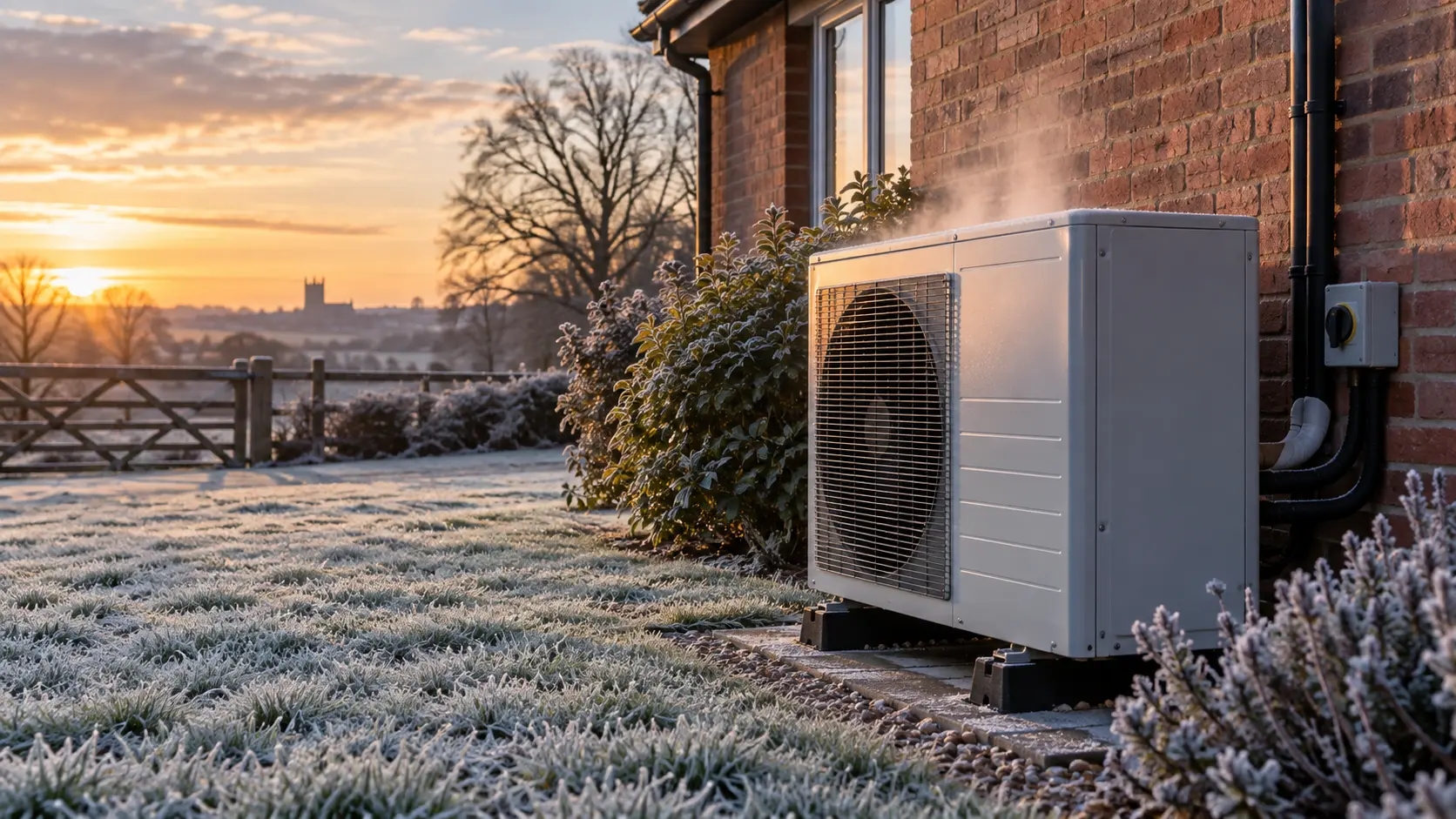
On a still, frosty morning you might glance at the heat pump outside, see a cloud of vapour coming from it and wonder if something’s wrong. It’s almost certainly fine. Air source heat pumps are designed to keep heating below freezing, and they clear frost from the outdoor unit with short defrost cycles. A correctly designed system keeps the house warm in a cold snap, provided it’s set up to run steadily. Our renewables page explains how we approach heat pump design in Lincolnshire.
Why heat pumps still work when it’s cold
A heat pump collects heat from outdoor air and concentrates it using a refrigerant cycle. Even air below zero contains heat that can be extracted. As the temperature drops, the heat pump has to work harder, so its efficiency falls, but it keeps going.
That’s why sizing matters. A system designed around a proper heat loss calculation for your home should cope with the coldest weather your area normally sees.
What defrost mode is
In cold, damp weather, frost builds up on the outdoor unit’s coil. The heat pump periodically reverses for a few minutes to melt it. During this time you may notice:
- Steam or vapour rising from the unit
- A whooshing sound or a pause in the fan
- Water dripping or draining from underneath
- Radiators cooling slightly for a short time
All of this is normal. If the unit is covered in thick ice that doesn’t clear, that’s a different matter.
Settings that help in winter
- Run it steadily. Heat pumps work best keeping the house at a stable temperature, not blasting heat for short periods. Big setbacks overnight can mean a long, less efficient recovery in the morning.
- Leave the weather compensation alone unless your installer has advised a change. It adjusts flow temperature to suit outdoor conditions.
- Don’t keep turning the thermostat up. It won’t heat the house faster.
- Keep radiator valves open in the main rooms, so the system has enough places to deliver heat.
Your installer’s handover notes should explain the right settings for your system.
Looking after the outdoor unit
- Keep a clear space around it, free of leaves, snow drifts, bins and garden furniture
- Make sure water can drain away from underneath, so meltwater doesn’t refreeze in a pile
- Don’t chip ice off the coil or pour boiling water on it, as the fins are delicate
- Don’t cover it to keep it warm, as it needs free airflow
When to call an engineer
- Thick ice that stays on the unit for hours
- The house won’t reach temperature even with settings unchanged
- Fault codes on the controller
- Unusual grinding, rattling or banging
- A sudden rise in electricity use with no change in weather or settings
Work on the refrigerant circuit needs an F-Gas certified engineer.
Cold snaps in Lincolnshire
Lincolnshire’s open landscape can bring cold, damp spells and frosty nights, which are exactly the conditions where defrost cycles happen most. Homes around Lincoln, Washingborough and Bracebridge Heath with heat pumps should see them running more often during these spells. If you’re weighing up whether one would suit your property, or comparing it with a new boiler, a survey is the place to start.
Frequently asked questions
Why is steam coming out of my heat pump?
That’s usually the defrost cycle. When frost builds on the outdoor coil, the heat pump briefly reverses to melt it, and the warm coil gives off vapour in cold air. It normally lasts a few minutes. If you see smoke rather than vapour, or smell burning, switch the unit off and call an engineer straight away.
Should I turn my heat pump off at night?
Usually no. Heat pumps are designed to run steadily and keep the house at a stable temperature. A small setback overnight can be fine, but switching off completely often means a long, hard recovery in the morning. Check what your installer recommends, as the best setting depends on your house and system design.
Do I need a backup heater for very cold weather?
A correctly sized system shouldn’t need one for normal UK winters. Some systems include an immersion heater or backup element for hot water or extreme conditions. If your heat pump struggles every cold spell, the design or settings may need looking at, so ask an engineer to check it over.
Questions about heat pumps in winter?
If your heat pump isn’t keeping up, or you’d like to know whether one would suit your home, give us a call on 07717 224 048 or drop us a message and we’ll talk it through with you.